GTA VI took 13 years. Your first version shouldn't.
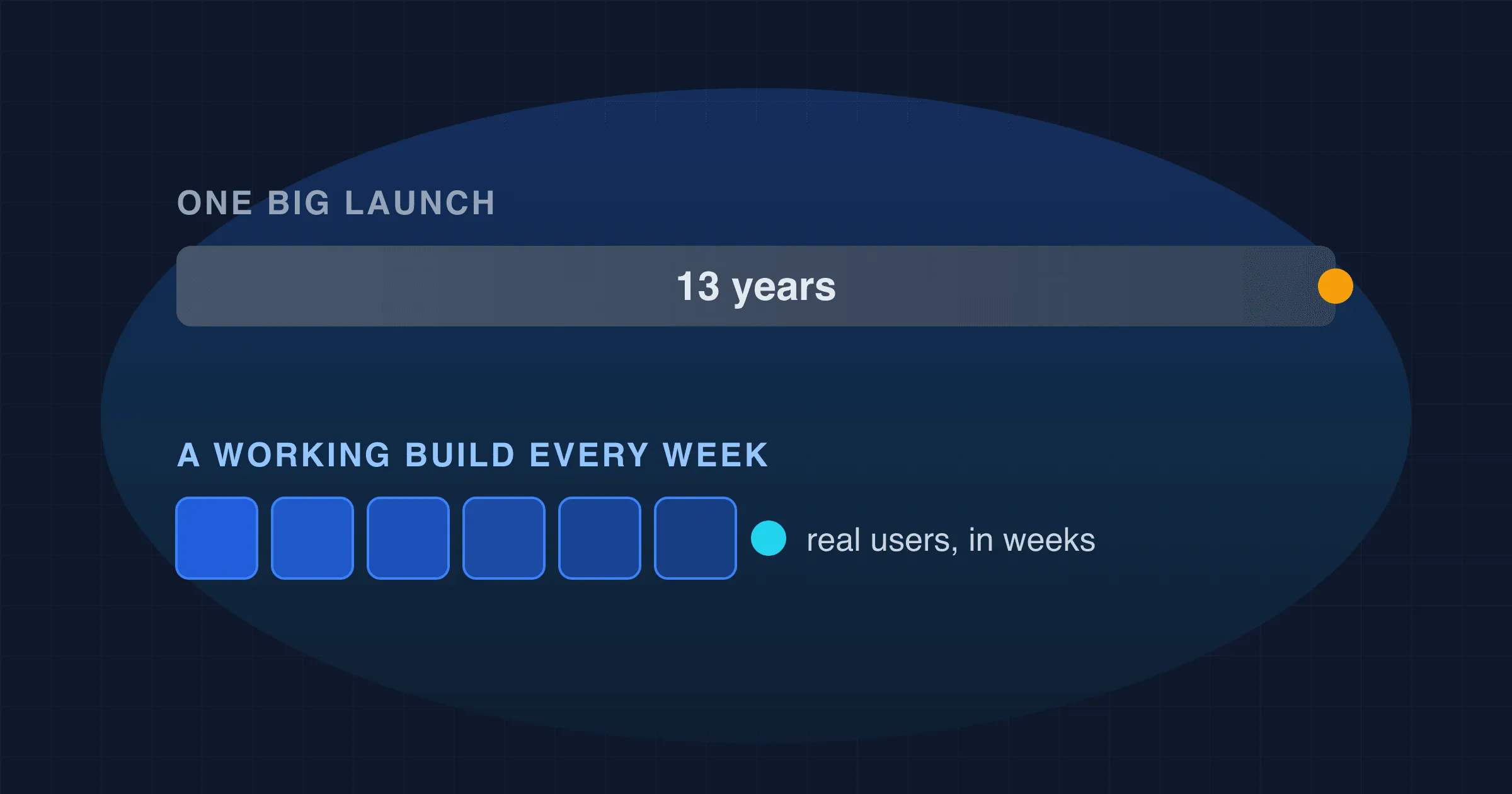
GTA VI shipped 13 years after GTA V. A new app has no waiting audience, so its first version should do one job well and reach real users in weeks.
By Oleksii Mykhalchuk — Engineer & software developer
Grand Theft Auto VI comes out today. GTA V came out in September 2013, so the gap between them is over 13 years. The first trailer appeared in December 2023 with a release window of fall 2025. In May 2025 Rockstar moved it to 26 May 2026, and in November 2025 it moved it again, to today.
Millions of people waited the whole time, and plenty of them have taken the day off. If you’re planning an app, a website or an AI tool for your business, it’s tempting to take one lesson from this: take as long as it takes and ship it when it’s perfect. For almost every business that isn’t Rockstar, that’s the wrong lesson. Here’s why, and what to copy from them instead.
Rockstar could wait because its demand was already proven
Rockstar didn’t spend those years wondering whether anyone wanted the game. The franchise was proven, the audience was huge, and GTA V and its online mode kept earning money the whole time the new one was being built. The demand already existed, so the only open question was quality. When the main risk is “will it be good enough?”, spending more time is a sensible answer.
A new product doesn’t start from there. You have an idea, maybe some conversations with customers who said they’d use it, maybe a competitor you think you can beat. None of that is demand yet. Your main risk isn’t “will it be polished enough?” It’s “will anyone use it, and for what?”
Spending more time doesn’t answer that question. Only real users do. Every month spent building before anyone uses the thing is a month spent building on a guess.
A first version exists to test the guess
That changes what “finished” means for a first release. It doesn’t have to be the whole vision. It has to be the smallest thing that lets a real person do the one job you think they’ll pay for, from start to finish.
In practice, these are the things I most often recommend leaving out of a first version:
- The admin dashboard. For the first months, the owner can usually manage data in a spreadsheet or a plain database tool. Nobody pays you for your back office.
- Every user role at once. Build for the person who gets the value, not for the five kinds of people who might touch the system someday.
- Every platform at once. iOS and Android and web on day one triples the surface you have to get right before you learn anything. Choose the one your first customers actually use.
- Features that exist because a competitor has them. Your competitor’s feature list shows what they’ve learned after years. It isn’t a requirement for your launch.
What I never leave out: login and data handling done properly, payments that work, and nothing that can lose a customer’s data. A thin first version is fine. A careless one isn’t.
This is also why I build in phases you can stop between, with a working build every week. Nobody should wait months to see whether the thing on the screen matches what was in their head, and every phase should end with something you could put in front of a customer.
Two delays, both announced months ahead
There is something worth copying from Rockstar, and it’s how they delayed.
Both delays were announced roughly six months before the date they replaced, each with a firm new date and a one-line reason: more time for polish. Nobody found out a week before launch, and nobody was handed a vague “soon”. The fans were disappointed and stayed anyway, because the plan was clear.
Most software projects get this backwards. The date slips quietly, week by week, and the client hears about it when the launch date arrives and the product doesn’t. That kills trust far faster than the delay itself.
So my rule, for my own projects and my clients’: if a date is going to move, say so as soon as you know, with a new date and the reason. Then decide whether it should move at all. Here’s how I decide:
Delay for anything that loses or exposes data, broken payments, a security hole, or a main flow that doesn’t work end to end. Shipping those costs more than waiting.
Ship anyway for visual polish, nice-to-haves, the second and third user role, and the feature someone thought of last Tuesday. Those belong in the next phase, after real users have told you which ones matter.
Where AI changes the timeline, and where it doesn’t
Writing code is much faster than it was even two years ago. I build with AI tools every day, and for a typical first version they cut the time spent typing out screens, forms and boilerplate by a large margin. That’s a big reason a useful first version can now take weeks rather than quarters.
But typing was never the slow part. Deciding what to build, testing it with real data, getting security right and making sure it doesn’t fall over on launch day all take about as long as they used to. AI-generated code that nobody has reviewed is also exactly where the security problems I get called in to fix come from. Faster code makes good scoping matter more, not less, because you can now build the wrong thing very quickly.
The honest exceptions
Some things really shouldn’t be rushed. If your product controls hardware, handles medical or financial data under regulation, or replaces a system a business runs on every day, the first version is necessarily bigger and slower, and pretending otherwise is how people get hurt. In those cases, the phased approach still applies, but the first phase is usually a prototype on test data, not a public launch.
And a first version can be too thin. If it’s so stripped down that users can’t tell what it’s for, it teaches you nothing. “Minimal” means one job done properly, not ten jobs done badly.
The short version
Rockstar spent 13 years because the world was already waiting and the only question was quality. You probably don’t have that luxury, and you don’t need it. Build the smallest version that does one job properly, put it in front of real people within weeks, and if the date has to move, say so early.
If you have an idea and want to know what its first version should actually include, and what it would cost, send it through the free project review. You’ll get a price range, a timeline and an honest scope within two working days, including whether you need a custom build at all.
Dates: Rockstar announced the first delay on 2 May 2025 and the second on 6 November 2025 (Rockstar’s announcement of the 19 November date, delay timeline). Grand Theft Auto is a trademark of Take-Two Interactive. This post isn’t affiliated with or endorsed by Rockstar Games.